
If vLLM already solved LLM serving, why did SGLang appear?

Updated on
Published on
By

Table of Content
About the author

GPU infrastructure used to have a clear job:
serve models fast and handle as many requests as you could throw at it.
The H100 generation was built for that, and it did it well.
The AI workloads worth talking about now need something more.
Reasoning models don’t just generate text – they plan, verify, loop back, and work through multi-step chains of logic before producing a response.
Agentic pipelines run multiple models in sequence across contexts that can stretch to hundreds of thousands of tokens. These workloads eat memory, demand sustained throughput over longer inference windows, and make the economics of the previous GPU generation look worse with every passing quarter.
The NVIDIA B300, built on the Blackwell Ultra architecture, is designed around this new reality.
The memory constraint has been the quiet tax on serious AI inference for a long time. Running a 70B parameter model on H100s meant planning for multi-GPU setups, accounting for the overhead that comes with sharding, and accepting that some of your memory bandwidth is going to inter-GPU communication rather than actual computation. At 100B+ parameters, the math gets harder.
At 200B+, you’re essentially building infrastructure around the constraint rather than around the workload itself.
The B300 ships with 288GB of HBM3e memory – more than three times the 80GB on a standard H100 SXM. That changes the size of problem that fits cleanly on a single GPU, and what “single GPU inference” even means in practice:
Access NVIDIA B300 GPUs built for reasoning, inference and long-context AI workloads.

Speed is the headline in most GPU announcements. But the more useful number for anyone making an infrastructure decision is cost per token – what it actually costs to serve a million requests, once you factor in power, hardware, and utilization. The B300’s numbers here are significant (compared to the Hopper generation):
For teams running a few hundred requests per day, this doesn’t change the conversation much. For teams running millions of inference calls monthly, or planning infrastructure that needs to handle that kind of scale – it’s the kind of number that restructures what’s worth building on.
The B300 is a data center GPU – not a workstation card, and not aimed at development or fine-tuning workflows on a single machine. The workloads it’s designed for are the ones where memory, sustained throughput, and cost-per-token economics are all important at the same time:
The B300 is coming to Neysa Velocis. If you want to be among the first to access B300 capacity on Velocis when it goes live, get in touch with the team.
Deploy, run, train, fine-tune and serve all open-source models. Scale with confidence.
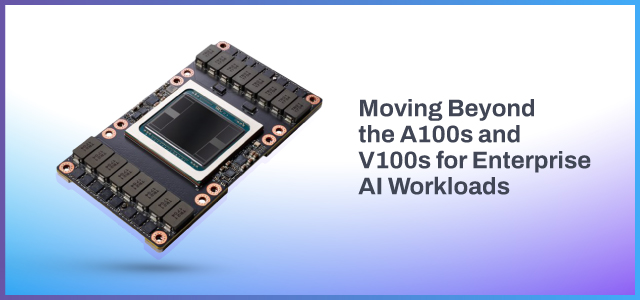
Upgrading to NVIDIA’s latest GPUs, such as the H100 and L40S, is essential for enterprises facing increasingly complex AI workloads. These next-gen models offer significant performance enhancements, reduced operational costs, and improved efficiency compared to older A100 and V100 GPUs. Acting promptly ensures a competitive advantage in the evolving AI landscape.
Choosing between the NVIDIA H100 and L40s isn’t about raw specs—it’s about matching GPU power to enterprise AI needs. The H100 excels at training massive LLMs and real-time inference at hyperscale, while the L40s offer scalable, cost-efficient performance for everyday AI workloads and inference at scale. In this comparison, we break down compute, memory, power, and cost trade-offs to help enterprises decide when to invest in H100s and when L40s make more sense for deployment, TCO, and hybrid strategies.

An enterprise GPU cloud is more than rented GPUs. Learn what makes AI infrastructure production ready: predictable GPU capacity, transparent costs, governance, data residency, and observability, and how Neysa Velocis helps enterprises move AI from notebook to production.