
If vLLM already solved LLM serving, why did SGLang appear?

Updated on
Published on
By

Table of Content
About the author

Imagine a tool that unlocks the potential of artificial intelligence, accelerates scientific breakthroughs, and brings stunning visuals to life—all without breaking the bank. Enter the NVIDIA L40S GPU, the latest marvel in NVIDIA’s lineup, designed to empower professionals and enterprises alike. Whether you’re an AI researcher, a data scientist, or a design professional, the L40S is here to redefine what’s possible.
In this guide, we’ll take you on a journey through the L40S GPU, exploring its features, performance, and why it’s a game-changer for industries ranging from AI to high-performance computing (HPC). Let’s dive in.
The NVIDIA L40S GPU isn’t just another graphics card—it’s a powerhouse built for the future. As the successor to the L40 GPU, it combines cutting-edge architecture with unparalleled performance, making it a standout choice for AI, machine learning (ML), HPC, and advanced visualizations.
Think of it as the Swiss Army knife of GPUs: versatile, powerful, and designed to handle the most demanding workloads with ease.
NVIDIA’s GPU lineup is like a constellation of stars, each shining in its own right. The L40S sits comfortably between mainstream GPUs and high-end GPUs like the H100. It’s the perfect middle ground for those who need top-tier performance without venturing into supercomputing territory. With 568 fourth-generation Tensor Cores, an 864 GB/s memory bandwidth, and a host of advanced features, the L40S is a bridge between affordability and high performance.
The L40S GPU is engineered to tackle the most complex computational tasks.
What it is good at:
Whether you’re training deep learning models, simulating weather patterns, or rendering ultra-high-resolution visuals, the L40S is up to the task.
The L40S is tailor-made for professionals and industries that demand high performance without compromise. Here’s a snapshot of its target audience:
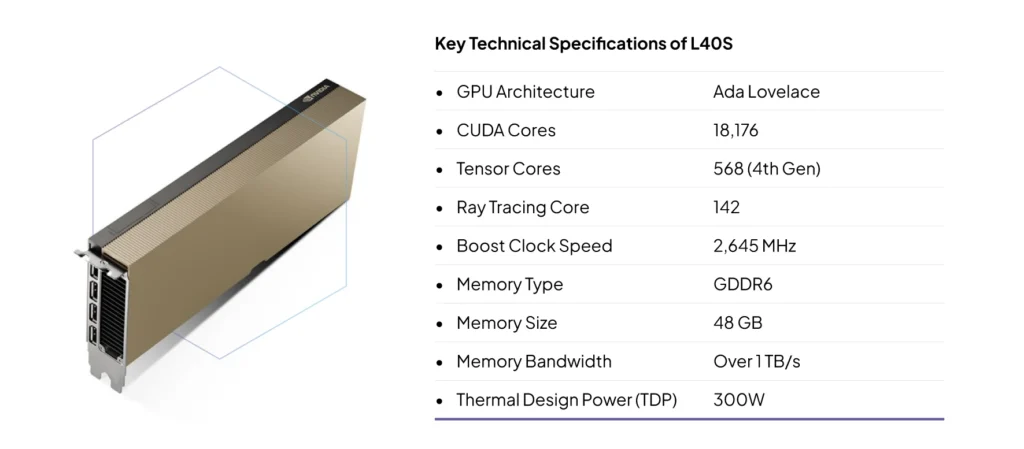
| Specification | Details |
| Architecture | Ada Lovelace |
| CUDA Cores | 18,176 |
| Tensor Cores | 568 (4th Gen) |
| Ray Tracing Cores | 142 |
| Boost Clock Speed | 2,645 MHz |
| Memory Type | GDDR6 |
| Memory Size | 48 GB |
| Memory Bandwidth | Over 1 TB/s |
| Thermal Design Power (TDP) | 300W |
| Comparison | Details |
| Versus NVIDIA L40 | The L40s GPU offers enhanced clock speeds and a higher number of CUDA cores, delivering almost 20% better performance. |
| Versus NVIDIA H100 | The H100 is a flagship product in the ultra-high-end computing range, but the L40s comes close in certain workloads along with being a more economical option. |
| Versus Competitors (AMD, Intel) | When compared to AMD’s Radeon Pro series or Intel’s upcoming GPUs, the L40s holds a significant advantage in terms of AI and ray tracing performance. |
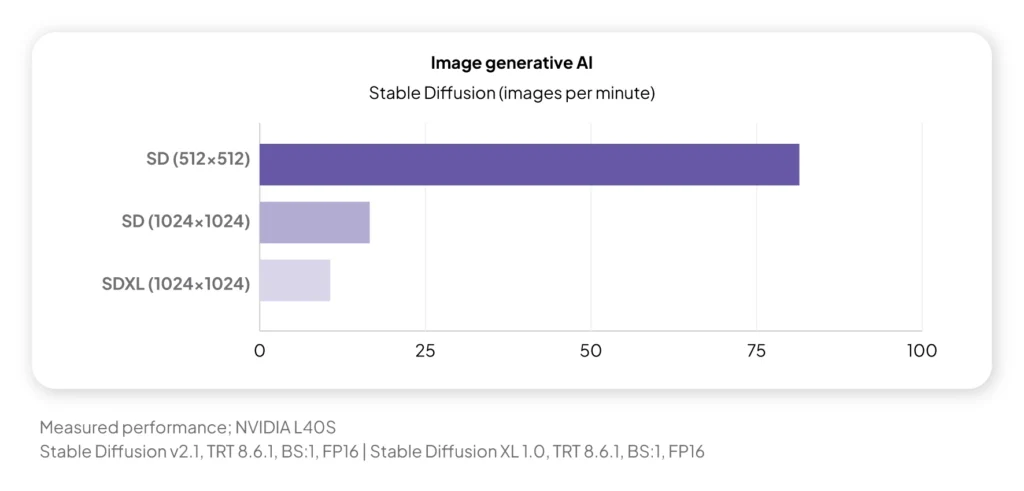
Source: NVIDIA Website
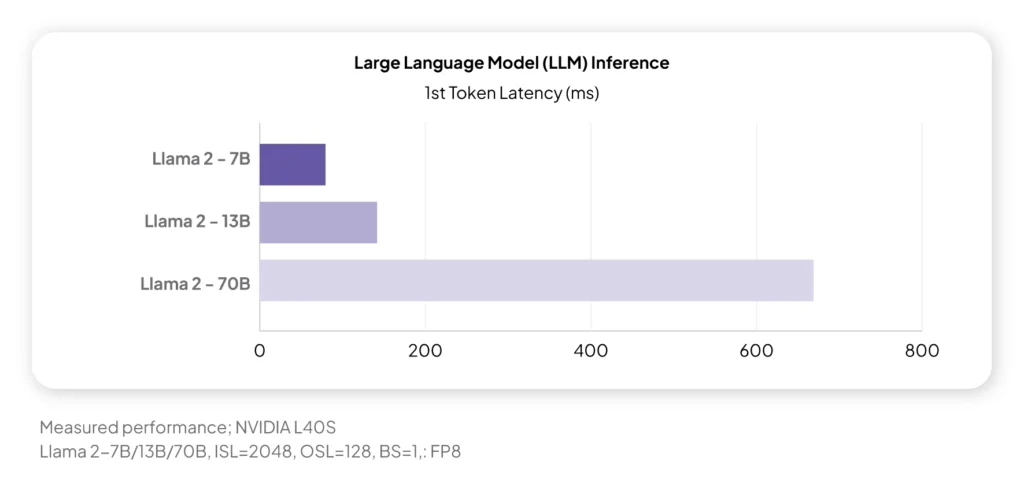
Source: NVIDIA Website
The L40s GPU can easily be integrated with platforms like:
This flexibility ensures that developers can leverage the GPU’s full potential without major changes to their existing infrastructure.
With a TDP of 300W, the L40S strikes a balance between performance and power efficiency. Its energy-efficient design not only reduces operational costs but also minimizes environmental impact.
| Memory Type | GDDR6 memory |
| Memory Size | 48 GB VRAM |
| Bandwidth and Latency Performance | Over 1 TB/s |
The superior memory and high bandwidth make the L40s ideal for big data analytics by efficiently processing large datasets without bottlenecks. It also handles intricate calculations required for scientific research. It also provides support for the rendering of ultra-high-resolution images and videos.
The NVIDIA L40S is built with the aim of providing scalability and reliability to hyper-scale data centres. Businesses can use it for cloud computing services, AI platforms and big-data processing.
NVIDIA officially released the L40S in mid-2023 and introduced it to the markets later in the year.
It can also be leveraged as a cloud service through providers such as Neysa, AWS, Azure etc.
The L40S is competitively priced, starting at approximately ₹4,50,000 in India (prices may vary based on configuration and seller). For those seeking flexibility, GPU cloud pricing from providers like Neysa, AWS, and Azure makes GPU-as-a-Service a viable option. Renting an L40S is a no-brainer, with rental prices starting at just $1.64 per hour.
The L40s offers an excellent price-to-performance ratio, providing near-flagship-level performance at a more accessible price point.
The L40s GPU supports new software technologies to maintain its long-term value and potential. Its robust build and specifications ensure it remains relevant for several years.
Gaming users who solely opt for GPUs that are primarily focused on enhancing gaming experience might find gaming-specific GPUs a better option. In terms of ultra-high-end performance needs, gaming users might also consider the H100 GPU irrespective of its high costs to fit their requirements.
Here are two options that are common alternatives to the NVIDIA L40S GPU:
NVIDIA L40S have a number of competitors available in the market, some of which are:
In comparison to previous generation GPUs, here are some differences:
The NVIDIA L40S GPU is more than just a piece of hardware—it’s a catalyst for innovation. Whether you’re pushing the boundaries of AI, conducting groundbreaking research, or creating stunning visuals, the L40S is your ultimate partner.
Ready to take your projects to the next level? The L40S is waiting.
See predictable GPU cloud pricing for your workload. Talk to an AI Expert about deploying on Neysa Velocis.
Neysa Aegis LLM Shield enhances AI security by inspecting prompts and responses outside the model, addressing vulnerabilities like prompt injection and sensitive data leaks, ensuring compliance and auditability in enterprise environments.

From decoding the human genome to enabling AI-powered diagnostics, High-Performance Computing (HPC) has redefined how healthcare operates. What once cost billions now drives real-time precision medicine, faster drug discovery, and equitable access to advanced treatments.