
If vLLM already solved LLM serving, why did SGLang appear?

Updated on
Published on
By

Table of Content
About the author

What’s powering your favourite AI chatbot, the coding agent that just opened a pull request, or the model reading your insurance claims?
Spoiler: it’s not just clever code or fancy models. Welcome to 2026, where AI has moved from answering questions to running whole workflows, and every agent call lands on a GPU. For most of the industry, that GPU still comes from NVIDIA.
And in 2026, NVIDIA’s lineup moves faster than most buying cycles. Blackwell Ultra (B300, GB300) has been shipping since the second half of 2025 and is the newest architecture running at scale. NVIDIA declared Vera Rubin in full production at CES in January, began its production ramp in May, and will start shipping in fall 2026. NVIDIA has already named what comes next: Rubin Ultra in 2027 and Feynman in 2028.
That’s the actual change. NVIDIA used to ship a new architecture roughly every two years. At Computex 2024, Jensen Huang moved the company to a one-year rhythm, and it has held that pace since.
So the newest GPU is now a moving target, and “which architecture should we run on?” is a question you’ll answer more than once. The good news: the answer follows a pattern. Every generation got faster at math, but the biggest jumps lately have come from memory and from how GPUs talk to each other.
Learn to read those three things and you can read any spec sheet NVIDIA publishes with ease.
Power AI workloads with GPU infrastructure built for performance and scale.
This guide starts with where NVIDIA stands in 2026, then walks through every architecture from Fermi (2010) to Feynman (2028), newest first, and what each one is good for in 2026.
NVIDIA GPU architectures at a glance
| Architecture | Year | Status | Key feature | Use cases |
| Feynman | 2028 | Planned | Next architecture after Rubin, paired with a new Rosa CPU and the Kyber rack with co-packaged optics. GPU specs not yet published | Future AI factories |
| Rubin Ultra | 2027 | Planned (H2 2027) | New Kyber rack (NVL144); NVLink scale-up to 576 GPUs across eight 72-GPU racks (NVL576) | Large-scale AI training and inference |
| Rubin (Vera Rubin) | 2026 | In production; partner shipments from H2 2026 | 288 GB HBM4 at up to 22 TB/s, 50 PFLOPS NVFP4 inference, NVLink 6 at 3.6 TB/s per GPU | Agentic AI, MoE training, large-scale inference |
| Blackwell Ultra | 2025 | Released (H2 2025) | B300 / GB300: 288 GB HBM3e at 8 TB/s, 1.5x the NVFP4 compute and 2x the attention speed of Blackwell | AI reasoning, long-context inference, large-model training |
| Blackwell | 2024 | Released | Dual-die GPU, FP4 Tensor Cores, NVLink 5 at 1.8 TB/s | GenAI training and inference, RTX 50 series, RTX PRO 6000 |
| Ada Lovelace | 2022 | Released | 4th-gen Tensor Cores with FP8, DLSS 3 frame generation | RTX 40 series, AI inference (L4, L40S), graphics and video |
| Hopper | 2022 | Released | Transformer Engine, FP8 | LLM training and inference, HPC |
| Ampere | 2020 | Released | 3rd-gen Tensor Cores, TF32, BF16, Multi-Instance GPU | AI training and inference, RTX 30 series |
| Turing | 2018 | Released | First real-time ray tracing, INT8 and INT4 Tensor Cores | Inference (T4), RTX 20 series |
| Volta | 2017 | Released | First Tensor Cores | Deep learning training |
| Pascal | 2016 | Released | HBM2, first NVLink, native FP16 | Early deep learning, GTX 10 series |
| Maxwell | 2014 | Released | Performance per watt | GTX 900 series, early GPU computing |
| Kepler | 2012 | Released | SMX design, first GPU Boost | GTX 600/700 series, Tesla K20 |
| Fermi | 2010 | Released | ECC memory, true cache hierarchy | Early AI, scientific computing, gaming |
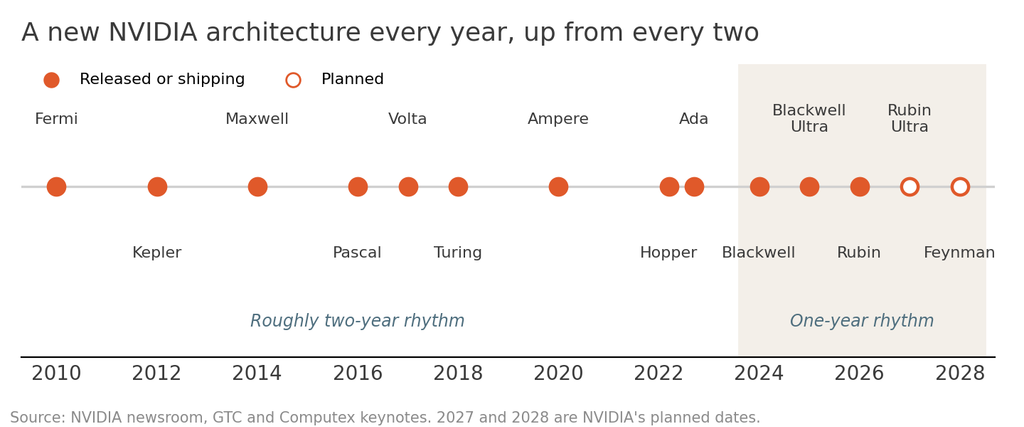
NVIDIA went from a new architecture every two years to one a year. Source: NVIDIA newsroom and GTC/Computex keynotes; 2027 and 2028 are NVIDIA’s planned dates.
Where NVIDIA stands in 2026
| Where it is in 2026 | Architecture | What it means for you |
| Planned | Feynman (2028), Rubin Ultra (2027) | Roadmap items. Plan around them, don’t launch on them |
| In production, shipping from fall 2026 | Rubin | The new top end. Capacity arrives first at the largest buyers |
| Newest at scale | Blackwell Ultra (B300, GB300) | The most memory per GPU you can deploy today, 288 GB |
| Mainstream new capacity | Blackwell (B200, RTX PRO 6000) | The common choice for new GenAI clusters and inference cards |
| Proven workhorses | Hopper (H100, H200), Ada Lovelace (L4, L40S) | Mature software and wide availability for fine-tuning and inference |
| Legacy | Ampere and older | Still running in many fleets, rarely bought new |
The four numbers that explain every generation
Before we climb the ladder, here’s the cheat sheet. Every NVIDIA generation moves four numbers, and they matter in this order for most AI teams today.
| The number | What it is | Why you care |
| Memory capacity | How much model, and how much KV cache (the model’s working memory for a conversation), fits on one GPU | Decides how many GPUs a model needs, and so how many you pay for |
| Memory bandwidth | How fast weights move from memory to the cores | Decides how fast tokens come out once the model is running |
| Interconnect (NVLink) | How fast GPUs share data with each other | Decides how well a model split across GPUs behaves like one big GPU |
| Math precision | The smallest number format the Tensor Cores run fast (FP16, FP8, FP4) | Each halving roughly doubles throughput, if your model’s quality holds |
Here’s how the first two have moved across the flagship data-center GPU of each generation.
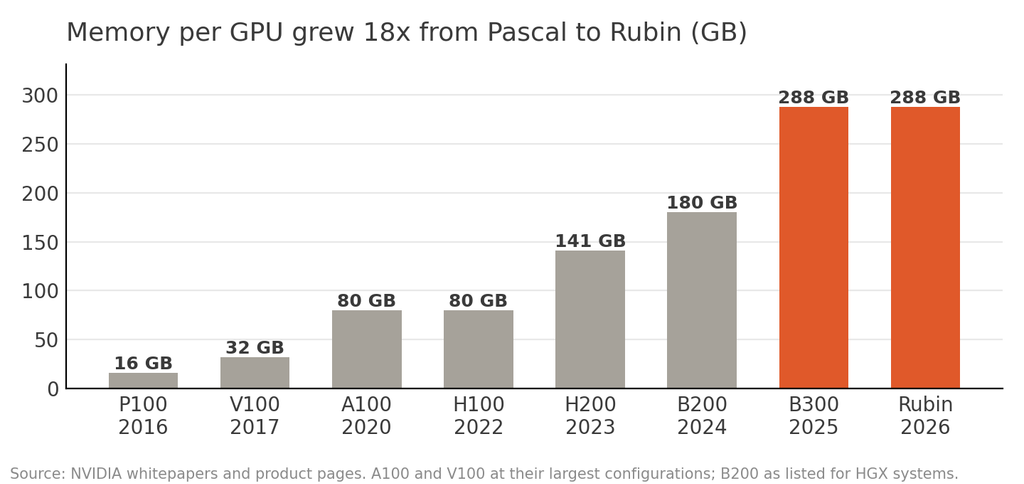
Per-GPU memory grew 18x from Pascal to Rubin. Source: NVIDIA whitepapers and product pages for P100, V100, A100, H100, H200, B200 (HGX), B300 and Rubin.
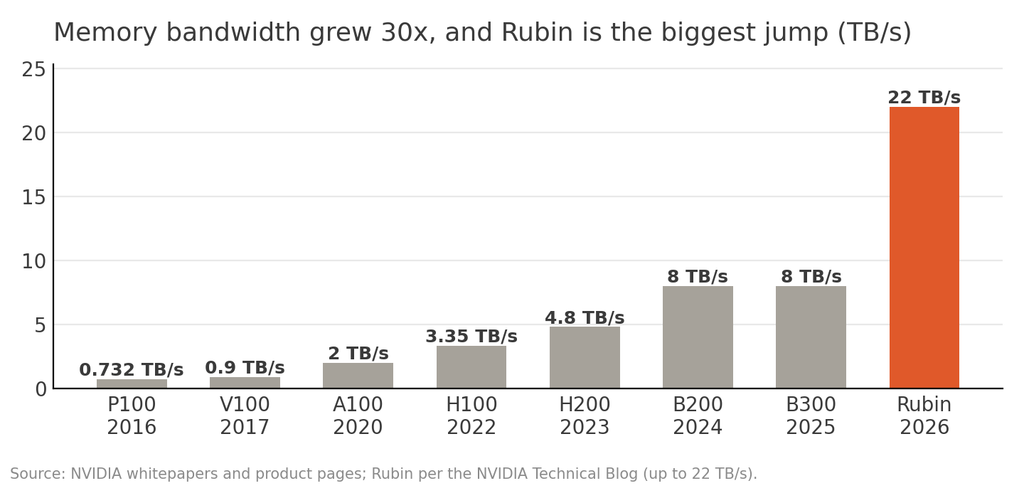
Memory bandwidth grew 30x, and Rubin’s jump is the biggest single step yet. Source: NVIDIA whitepapers and product pages; Rubin per NVIDIA Technical Blog.
Notice the flat step from B200 to B300 on bandwidth, and from B300 to Rubin on capacity. NVIDIA tends to move one lever hard per generation. That’s why “newer” doesn’t always mean “better for my model.” It means “better at the thing this generation pushed.”
Precision tells the same story from the compute side. Each generation added a smaller, faster number format.
| Generation | New Tensor Core format | What it made possible |
| Volta (2017) | FP16 with FP32 accumulate | Mixed-precision training became standard |
| Turing (2018) | INT8, INT4 | Fast, low-cost inference |
| Ampere (2020) | TF32, BF16, 2:4 sparsity | Faster training without code changes |
| Hopper (2022) | FP8 (Transformer Engine) | LLM training and inference at roughly 2x FP16 throughput |
| Blackwell (2024) | FP4 | Another doubling for inference |
| Blackwell Ultra (2025) | Faster NVFP4 | 1.5x the NVFP4 compute of Blackwell |
| Rubin (2026) | NVFP4 with adaptive compression | 50 PFLOPS NVFP4 inference per GPU |
Feynman (2028): The Next Chapter (Planned)
Feynman is the architecture after Rubin. At GTC 2026, NVIDIA said it will pair with a new CPU called Rosa, new BlueField-5 and CX10 networking, and the Kyber rack with co-packaged optics for scale-up. The 2028 date comes from NVIDIA’s GTC 2025 keynote roadmap.
That’s most of what NVIDIA has said officially. Per-GPU memory, bandwidth and compute have not been published. You’ll see plenty of Feynman spec tables online today. Treat them as guesses until NVIDIA prints them.
For your planning: Feynman matters if you’re signing a multi-year AI-factory build now. For everyone else, it’s a reason not to over-commit to any single generation.
Rubin Ultra (2027): Scale-Up Goes to 576 GPUs (Planned)
Rubin Ultra is the 2027 step, with systems due in the second half of 2027 and a Kyber platform of Rubin Ultra GPUs planned by 2027. The big news is the rack.
Rubin Ultra introduces Kyber, NVIDIA’s next rack design, which first arrives as a standalone 144-GPU system (NVL144). Separately, NVIDIA says a two-layer NVLink topology will join eight standard 72-GPU racks into one 576-GPU NVLink domain (NVL576), using copper and direct optical links. So Rubin Ultra comes in three scale-up sizes: 72, 144 and 576 GPUs.
Why that matters: a bigger NVLink domain means a larger model can be split across more GPUs while still behaving like one machine. Here’s how far that domain has grown.
| System | Generation | GPUs in one NVLink domain |
| HGX H100 | Hopper | 8 |
| GB200 NVL72 | Blackwell | 72 |
| GB300 NVL72 | Blackwell Ultra | 72 |
| Vera Rubin NVL72 | Rubin | 72 |
| Vera Rubin Ultra NVL144 (Kyber) | Rubin Ultra (planned) | 144 |
| Vera Rubin Ultra NVL576 | Rubin Ultra (planned) | 576 |
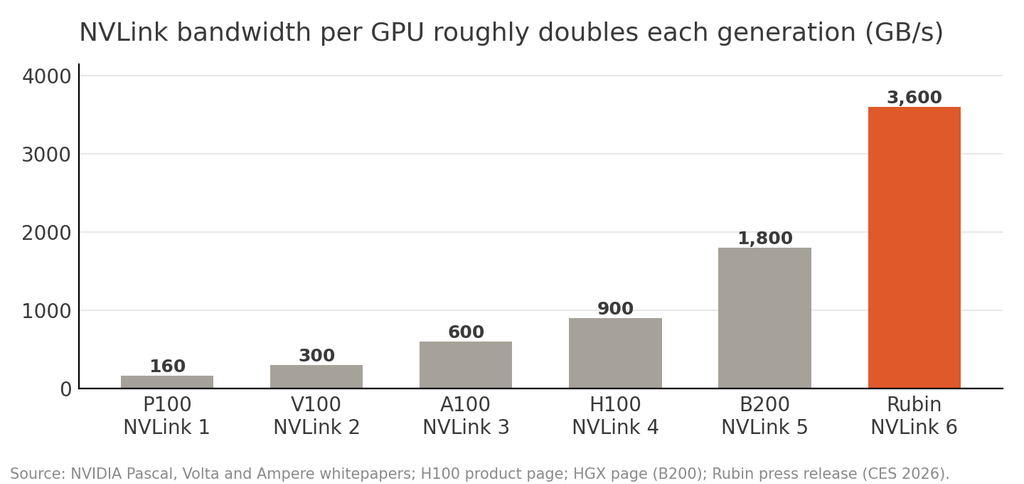
NVLink bandwidth per GPU has doubled almost every generation. Source: NVIDIA Pascal, Volta and Ampere whitepapers; H100, HGX and Rubin press materials.
Rubin (2026): Built for Agentic AI
Rubin is the newest NVIDIA architecture in production in 2026. NVIDIA announced it in full production at CES 2026, and production shipments begin in fall 2026.
Rubin is a platform more than a chip. At CES 2026, NVIDIA described six new chips designed together: the Vera CPU (88 custom Olympus cores), the Rubin GPU, the NVLink 6 Switch, ConnectX-9 SuperNIC, BlueField-4 DPU and Spectrum-6 Ethernet switch.
The Rubin GPU itself:
NVIDIA claims up to 10x lower inference token cost and 4x fewer GPUs to train mixture-of-experts (MoE) models compared with Blackwell. Those are vendor numbers, so wait for MLPerf before you build a business case on them.
There’s also a specialist sibling. Rubin CPX pairs 128 GB of GDDR7 with 30 PFLOPS of NVFP4 and is built for the prefill phase of very long-context inference (the part where the model reads your prompt). NVIDIA expects it at the end of 2026.
Who Rubin is for: agentic workloads, where one user request fans out into many model calls with long contexts, and large MoE models where memory bandwidth is the bottleneck.
Blackwell Ultra (2025): Built for AI Reasoning
Blackwell Ultra was announced at GTC 2025 and has shipped since the second half of 2025, as the HGX B300 eight-GPU board and the GB300 NVL72 rack.
It’s a refinement of Blackwell aimed at reasoning models, which “think” by generating many tokens before answering:
For data teams, that memory is the story. A 288 GB GPU holds a large model plus a long KV cache without splitting across as many cards, which keeps latency steady as conversations get longer.
Blackwell (2024): Architected for GenAI at Scale
Blackwell was unveiled at GTC 2024 and was built explicitly for generative AI at scale. The B200 joins two reticle-limited dies with a 10 TB/s chip-to-chip link so they behave as one GPU, for 208 billion transistors in total.
Key upgrades over Hopper:
Blackwell also reached workstations and gaming. The RTX 50 series launched in early 2025, and the RTX PRO 6000 Blackwell Server Edition brings 96 GB of GDDR7 to the data center, a strong fit for inference, visual computing and smaller fine-tunes.
In 2026, Blackwell is a common choice for new GenAI capacity, and the RTX PRO 6000 puts Blackwell features in a flexible PCIe card.
Ada Lovelace (2022): Inference and Graphics in One Chip
Ada Lovelace arrived in September 2022, six months after Hopper, and it’s the architecture behind the RTX 40 series. In the data center it powers the L4 and L40S, two of the most widely used inference GPUs today.
Ada brought fourth-generation Tensor Cores with FP8 support, third-generation RT Cores, and DLSS 3 frame generation.
Ada uses GDDR memory, not HBM, so it can’t match Hopper on bandwidth. But for smaller models, vision, speech and video, it often delivers the best cost per result in the fleet.
Hopper (2022): Built for Transformers and LLMs
Hopper took NVIDIA’s AI ambitions to a new level. The flagship H100 introduced the Transformer Engine, which switches between FP8 and FP16 layer by layer to speed up transformer models like GPT and Llama while holding accuracy.
The H100 SXM pairs fourth-generation Tensor Cores with 80 GB of HBM3 at 3.35 TB/s and NVLink 4 at 900 GB/s per GPU. It was also the first GPU with confidential computing. The H200 kept the same chip and moved to 141 GB of HBM3e at 4.8 TB/s, which made a big difference for inference on larger models.
Hopper was the workhorse of the frontier-model era. Meta trained Llama 3 405B on up to 16,384 H100 GPUs.
For data geeks, Hopper still does a lot in 2026. It runs every major framework without surprises, and H100 and H200 capacity is easier to get than the newest parts. For most fine-tuning and production inference, it’s still a smart default.
Ampere (2020): The Production-Ready AI Workhorse
With Ampere and the A100, NVIDIA brought serious gains for both training and inference. Ampere introduced third-generation Tensor Cores with TF32 (FP32-range math at Tensor Core speed, no code changes) and BF16, plus 2:4 structured sparsity, which skips zero values to double throughput on supported models.
The A100 came with 40 GB of HBM2 or 80 GB of HBM2e at about 2 TB/s, and NVLink 3 at 600 GB/s. It also introduced Multi-Instance GPU (MIG), which splits one GPU into up to seven isolated instances. That mattered for shared environments, because AI labs could hand fractional GPUs to different teams.
Ampere trained the first wave of open LLMs. Meta’s original LLaMA 65B ran on 2,048 A100 80 GB GPUs. It’s still widely deployed, though in 2026 most new capacity is Hopper or newer.
Turing (2018): Balancing Graphics and Inference
Turing balanced AI, real-time ray tracing and graphics. It was not a go-to for training large models, but the T4 became the go-to card for inference at scale.
Turing’s Tensor Cores added INT8 and INT4 precision, and it debuted RT Cores for real-time ray tracing. Lower-precision formats shrank models and raised throughput, which made Turing useful for chatbots, recommendation engines and edge deployments. The T4 ran at just 70 W with 16 GB of GDDR6.
Turing also democratized AI computing. The RTX 20 series let startups and hobbyists experiment without buying data-center hardware.
In 2026, the T4 mostly lives on in older inference fleets. New deployments usually choose newer cards like the L4.
Volta (2017): Where Tensor Cores Begin
Volta marked the true turning point for AI. The Tesla V100 brought the first generation of Tensor Cores, hardware built for one job: the matrix multiplications at the heart of deep learning. They multiply in FP16 and accumulate in FP32, which is what made mixed-precision training practical.
Each V100 came with 5,120 CUDA cores, 640 Tensor Cores, up to 32 GB of HBM2 at 900 GB/s, and NVLink 2 at 300 GB/s. Frameworks like TensorFlow and PyTorch added mixed-precision support in this era to put those Tensor Cores to work.
Volta trained the first large transformers. NVIDIA’s Megatron-LM scaled an 8.3 billion parameter model across 512 V100 GPUs. For infrastructure leads, Volta was the proof that dedicated AI hardware could vastly outperform general-purpose compute.
In 2026, the V100 has aged out of most production AI work, but every Tensor Core since descends from it.
Pascal (2016): The Foundation of Modern Parallelism
Pascal was NVIDIA’s first big step into deep learning, even though it wasn’t built only for AI. The Tesla P100 came with 3,584 CUDA cores, 16 GB of HBM2 at 732 GB/s, native FP16, and the first version of NVLink at 160 GB/s. It also improved unified memory between CPU and GPU.
Pascal has a famous place in AI history. The original Transformer paper, “Attention Is All You Need”, trained its models on one machine with 8 NVIDIA P100 GPUs. Every LLM you use today descends from that architecture.
In 2026, Pascal is retired from serious AI work, but it still turns up in teaching labs and light image processing.
Maxwell (2014): Power Efficiency Meets Performance
Maxwell was a big leap in power efficiency. It debuted on the GTX 750 Ti in early 2014, and the GTX 980 and GTX 970 followed later that year. The redesigned streaming multiprocessor delivered far more performance per watt than Kepler.
The GTX 980 shipped with 2,048 CUDA cores and 4 GB of GDDR5. Maxwell wasn’t built for deep learning, but it handled image processing, light inference and budget machine learning in research labs, and it brought a lot of developers into GPU computing. In 2026, Maxwell cards are long retired from AI work.
Kepler (2012): Efficient Parallelism and Flexibility
Kepler established NVIDIA as the leader in GPU computing for both graphics and general-purpose work. The GeForce GTX 680 (GK104) introduced GPU Boost, and the larger GK110 chip powered the Tesla K20 for data centers.
Kepler introduced the SMX streaming multiprocessor, plus Dynamic Parallelism (GPU work that launches more GPU work) and Hyper-Q (many CPU cores feeding one GPU at once). Research labs used Kepler GPUs for some of the first deep learning experiments in image recognition.
Kepler was the bridge to the specialized architectures that followed, especially in scalability and real-world performance. In 2026, it matters as history rather than hardware.
Fermi (2010): Where GPU Computing Got Serious
Fermi established GPUs as serious parallel computing engines, for graphics, scientific simulation and early AI alike. It was the first NVIDIA architecture with ECC memory and a true cache hierarchy, both essential for accurate high-stakes computation, and it made a big leap in double-precision performance.
The full Fermi chip had 512 CUDA cores and supported CUDA, OpenCL and DirectCompute.
Here’s the fun part: Fermi is where modern deep learning started. AlexNet, the 2012 network that kicked off the deep learning boom, was trained on two GTX 580 GPUs, a Fermi gaming card. In 2026, Fermi is a museum piece, but the deep learning boom traces straight back to it.
From two gaming cards to sixteen thousand GPUs
Put the landmark training runs side by side and you can see the ladder we just climbed.
| Year | Model | GPUs used | Architecture |
| 2012 | AlexNet | 2 x GTX 580 | Fermi |
| 2017 | Transformer | 8 x P100 | Pascal |
| 2019 | Megatron-LM 8.3B | 512 x V100 | Volta |
| 2023 | LLaMA 65B | 2,048 x A100 80 GB | Ampere |
| 2024 | Llama 3 405B | Up to 16,384 x H100 | Hopper |
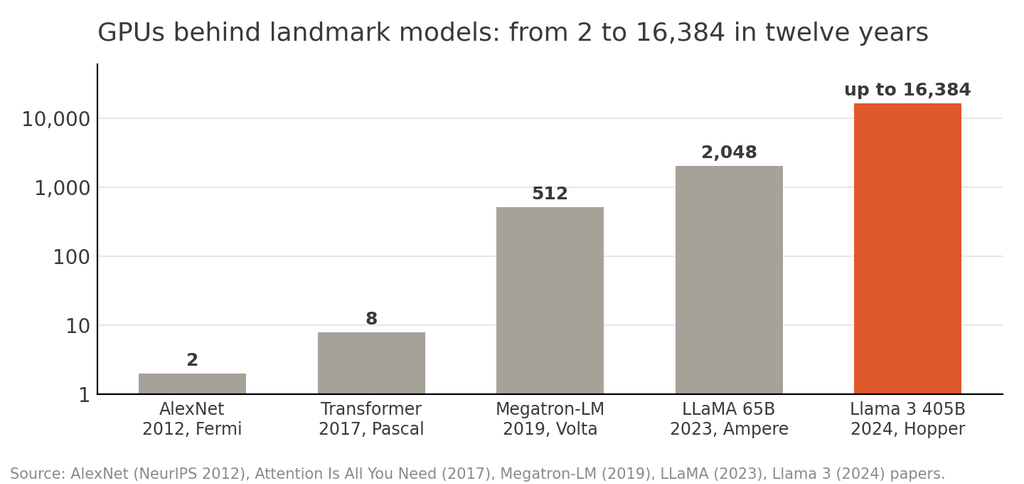
The GPUs behind landmark models grew more than 8,000x in twelve years. Source: the AlexNet, Transformer, Megatron-LM, LLaMA and Llama 3 papers.
Conclusion: A Mentor’s Take on Climbing the GPU Architecture Ladder
The world of AI is scaling faster than ever, and beneath every impressive output sits a layer most people never look at: GPU architecture.
If you’ve made it this far, you know the newest name on the box rarely settles it. Your model size, use case, team and growth horizon do. Here’s the memory math that usually decides it.
| Worked example. A 70 billion parameter model needs about 140 GB just for its weights at FP16 (2 bytes per parameter), or about 70 GB at FP8. On an 80 GB H100, the FP8 version barely fits and leaves almost no room for the KV cache, so you’d split it across two GPUs. On a 141 GB H200, the FP8 weights leave about 70 GB for the KV cache. On a 288 GB B300, even the FP16 weights fit with about 148 GB to spare. Same model, three very different bills. |
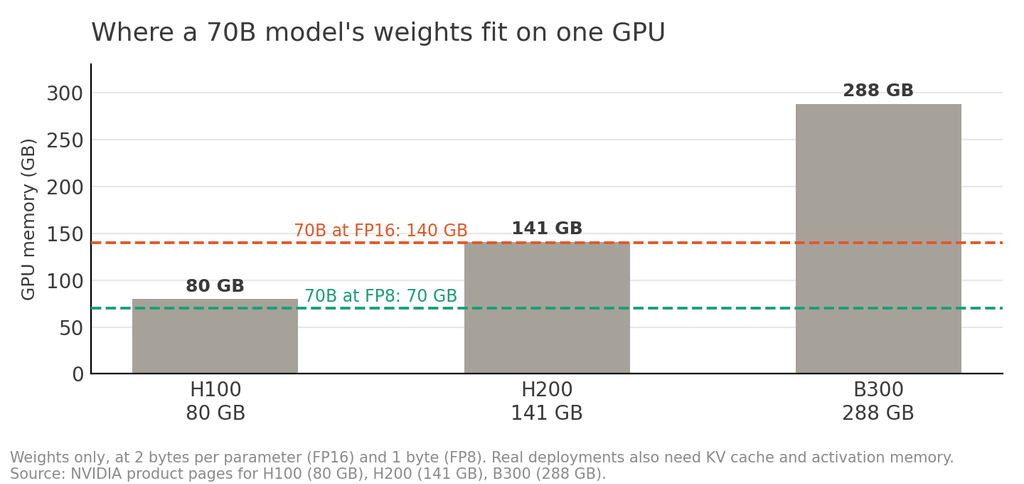
The same 70B model fits very differently on each generation. Weights only; real deployments also need room for the KV cache and activations. Source: NVIDIA product pages; arithmetic at 2 bytes per parameter (FP16) and 1 byte (FP8).
And here’s how we’d map common jobs to architectures in 2026:
| Your workload | Architecture to start with | Why |
| Video, vision, speech, small-model inference | Ada Lovelace (L4, L40S) | Low power, low cost per result |
| Fine-tuning and production LLM inference | Hopper (H100, H200) | Mature software, widely available |
| Inference plus graphics or visual AI | Blackwell (RTX PRO 6000) | 96 GB of memory in a flexible card |
| Long-context reasoning, large MoE models | Blackwell Ultra (B300) | 288 GB per GPU keeps big models on fewer GPUs |
| Frontier training and agentic AI at scale | Rubin, as capacity arrives | Biggest bandwidth jump in the history |
Three rules from years of helping teams climb this ladder:
Here’s where Neysa Velocis comes in. Velocis runs NVIDIA L4 and L40S (Ada Lovelace), H100 and H200 (Hopper), RTX PRO 6000 (Blackwell) and B300 (Blackwell Ultra), alongside AMD Instinct GPUs. Every one is available as bare metal. The L4 through H200 also run as GPU VMs and on managed Kubernetes, and dedicated inference endpoints serve your models in production. So you can start on the architecture that fits today and move up the ladder when your model does. Predictable pricing with discounts for long-term commitments.
Our engineers help you size it and set it up.
Deploy, run, train, fine-tune and serve all open-source models. Scale with confidence.
Voice AI, more than most AI applications, exposes the gap between what looks impressive and what actually works at scale.
This blog explores from our conversation with Akshat Mandloi – CTO & Co-Founder of Smallest.ai
This blog deep dives into the increasing costs of AI inference compared to training, with Deloitte forecasting inference to dominate AI compute expenses by 2026. Spotlights three key metrics – time to first token, tokens per second, and queue depth – in evaluating model performance. These metrics help teams optimize user experience and manage costs effectively.