
If vLLM already solved LLM serving, why did SGLang appear?

Updated on
Published on
By

Table of Content
About the author

Every time someone uses an AI model, it runs inference, reading the request and producing an answer, token by token, and you pay for every token. It runs every day the model is live, and grows with every user.
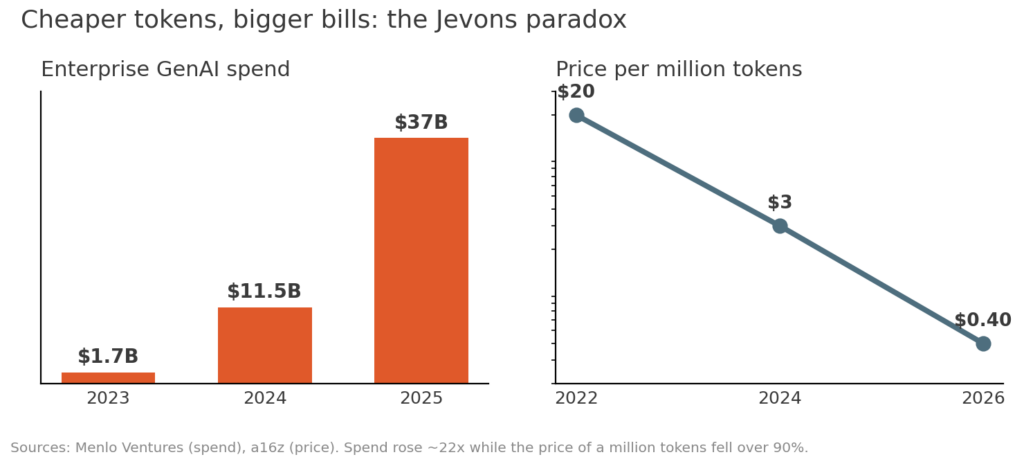
So the bill keeps rising even as each token gets cheaper, and in ways that are hard to predict. Making inference the biggest line in most AI budgets, and one that’s hard to forecast. It’s the same three-way pull between throughput, latency and cost every production AI team ends up managing.
Enter MI350X.
The MI350X serves each token for less: its 288GB memory runs a large model on fewer GPUs [v/s other GPUs with lower memory], and its FP4 engine pushes more tokens through each one, at roughly $0.17 per million. Neysa Velocis runs that chip as a production service, dedicated endpoints your app calls, with the storage, networking and orchestration behind them, and spend you can trace. Use them together, and you get reliable AI inference at predictable speed and cost, even as you scale.
At this point you might be wondering: “will my AI model even run on AMD chips?” – It does, with no rewrite, and we cover it in the companion post, “Will Your AI run on AMD?”.
Start with the chip. Two things make the MI350X cost effective per token, and both come down to serving more workloads on less hardware.
The first lever is memory.
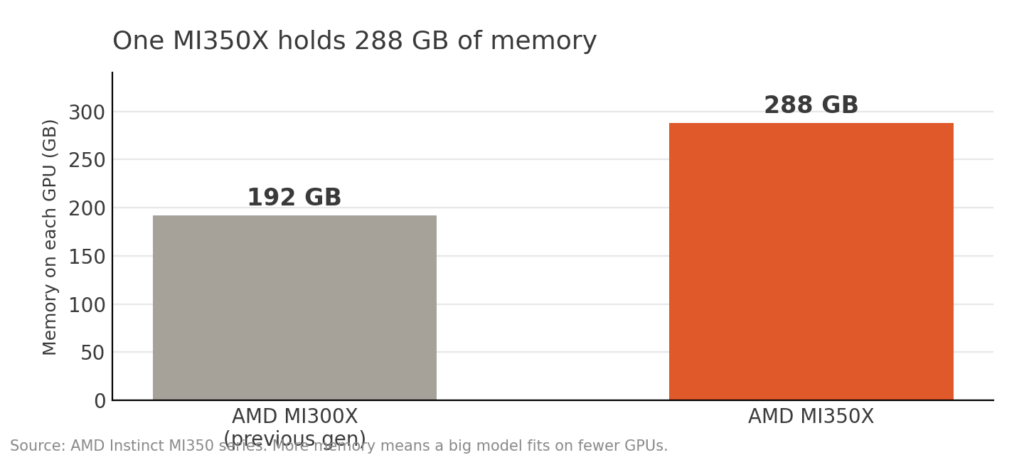
A model has to fit in a GPU’s memory to run, and the MI350X carries 288GB of it on a single card, enough to hold a large model that would otherwise be split across two or three GPUs. Fewer GPUs for the same model
The second lever is precision.
An AI model consists of billions of variables. Storing each one with fewer digits shrinks the model’s overall size, allowing it to run much faster.
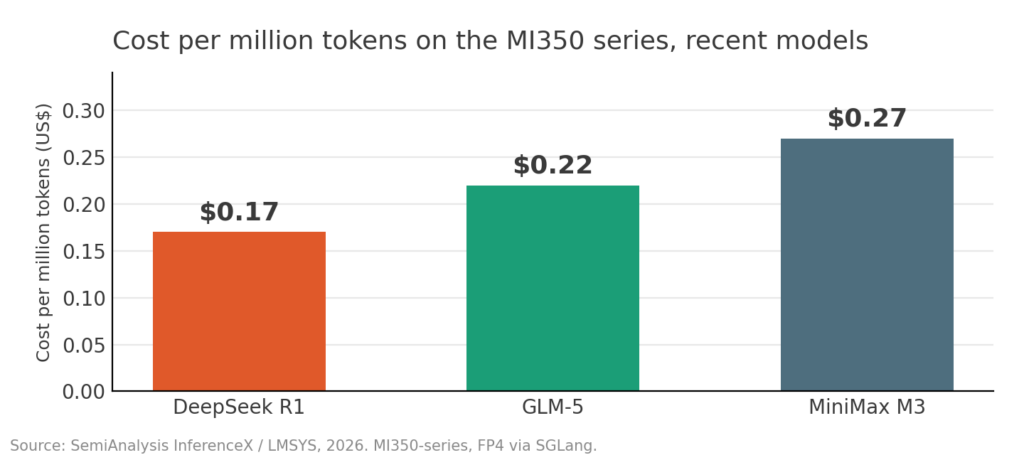
The MI350X handles the newer FP4 and FP6 formats natively, so it packs each model tighter and pushes more tokens through the chip for the same electricity, at a loss of accuracy most workloads never notice. Together, memory and precision land the cost that independent testing has measured: DeepSeek R1 at about $0.17 per million tokens, GLM-5 near $0.22, and on Llama-class models, up to 40% more tokens per dollar than a competing chip.
Cheap only helps if it’s also fast, and the MI350 series is fast. MLPerf is the industry’s go-to benchmark, and in its 2026 round, a single eight-GPU server served gpt-oss-120B at about 95,000 tokens a second and Llama 2 70B over 100,000, and scaled past a million a second across eleven servers.
| The claim | The number |
| gpt-oss-120B, one 8-GPU server | ~95,000 tokens/sec |
| Llama 2 70B, one 8-GPU server | 100,282 tokens/sec |
| Scaled across 11 servers | Over 1,000,000 tokens/sec |
| DeepSeek R1, per GPU | ~2,400/sec at ~$0.17 / million |
| GLM-5, per GPU | ~$0.22 / million tokens |
| The chip itself | 288GB memory, 8TB/s, FP4/FP6 |
Raw throughput is only half of what matters, though. Total tokens per second tells you how much the whole server produces; it says nothing about how any one user’s request feels.
What a user feels is responsiveness, how quickly the first word appears, and how many tokens a second they get while thousands of other requests are in flight at the same time. The MI350 series holds those steady as that concurrency climbs, so a spike in traffic doesn’t turn into a spike in latency. That’s the predictable-speed half of the promise: the service stays fast as it grows, not just on a quiet benchmark.
A fast, cheap chip still isn’t inference. Turning it into a service real users can hit takes a whole stack around it:
Miss any one of these and even the fastest chip sits idle much of the time. This is the gap between owning GPUs and running inference in production.
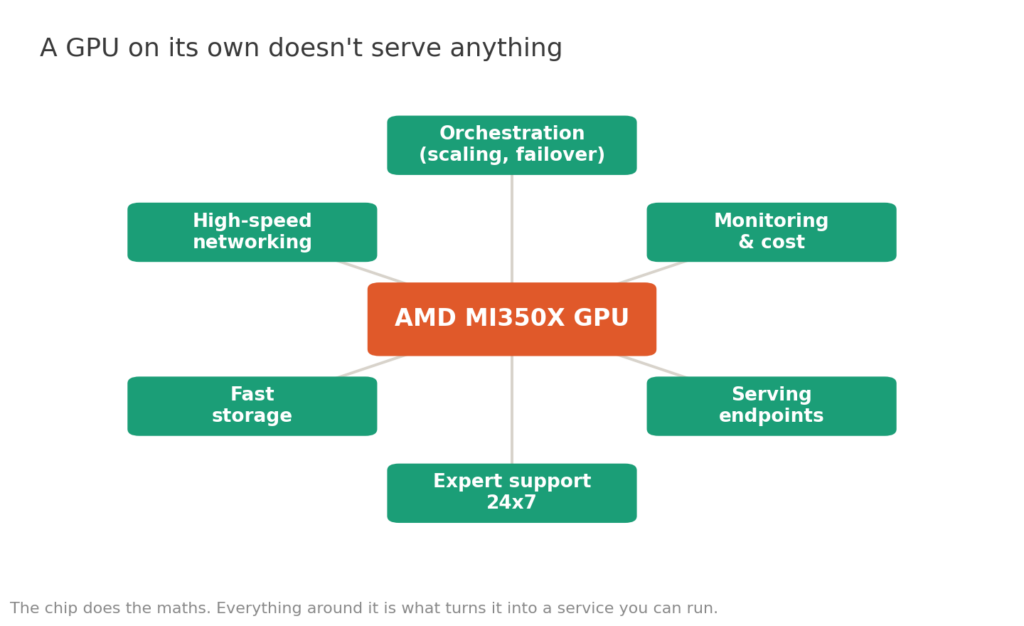
Neysa Velocis covers the whole stack – storage, networking, orchestration, secure endpoints and monitoring built around the chip, with the MI350X as one of the GPUs you can run on it, and the only Indian cloud recommended in SemiAnalysis’s ClusterMAX rating of GPU clouds, an independent grade of exactly the things a chip can’t do alone.
Every part of it is built to keep inference reliable and its cost in view:
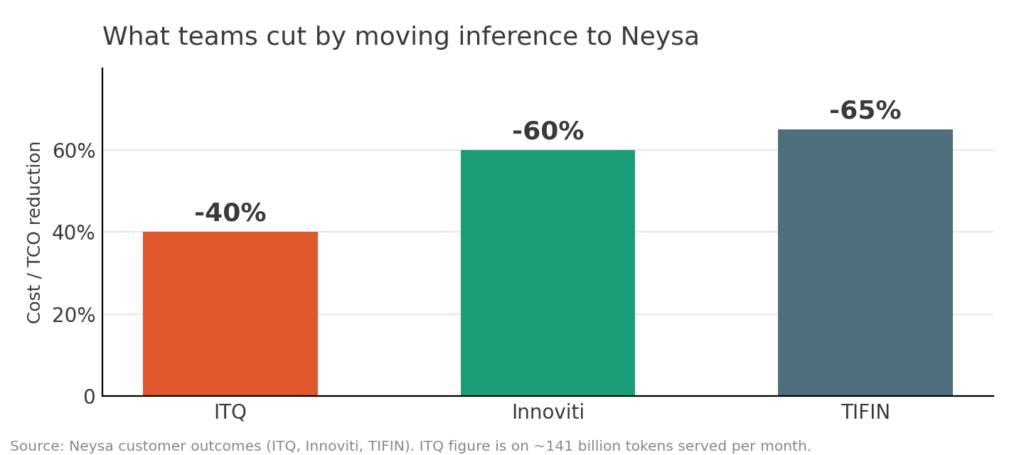
The savings are real. Take ITQ, one of India’s leading travel-technology companies. It serves fare-rule and refund logic on custom models running on Velocis, around 141 billion tokens a month, and moving to Neysa cut its cost 40% while pulling P99 latency from 14 seconds down to under two. Its CIO, Anil Porter, put it plainly:
“By partnering with Neysa, we have finally moved past the latency and cost barriers of legacy infrastructure to a system that handles our scale with total reliability.”
ITQ isn’t alone. TIFIN, in wealth management, cut its inference cost 65%; Innoviti, running a multimodal verification engine across a 50,000-merchant network, cut its total cost of ownership 60%.
Inference is the bill that never stops, and it grows with your success. The MI350X makes each token cheaper to serve; Neysa Velocis keeps it fast, reliable and visible as you scale. The only way to know what that does to your numbers is to run it on your own traffic: put one live model on an MI350X, and watch the cost per token.
Optimise inference economics with high-performance GPU infrastructure built for scale.

AI cloud migration is essential for transitioning AI models from development to real-world applications. It enhances scalability, flexibility, and efficiency, allowing teams to navigate challenges while optimizing costs and compliance through hybrid cloud solutions, ultimately facilitating rapid innovation.