
If vLLM already solved LLM serving, why did SGLang appear?

Updated on
Published on
By

Table of Content
About the author

The price of a GPU has always had a logic to it. When a new generation launches – the old ones get cheaper, and the market moves in a fairly predictable direction if you wait long enough. That logic stopped working sometime in 2025, and by 2026 it has broken down entirely: prices are rising across every tier of the GPU market, from entry-level cards to flagship accelerators, and the explanation has almost nothing to do with the GPUs themselves. It starts in a corner of the semiconductor industry that most enterprise buyers have never had reason to think about. And understanding it changes how you think about GPU procurement, cloud pricing, and infrastructure planning for the next two to three years.
Most of us are familiar with the idea that a GPU has memory – the VRAM that determines how large a model you can run or how many simultaneous tasks you can process. What’s less understood is that there are fundamentally different types of memory serving different parts of the computing ecosystem, and they all compete for the same manufacturing resources.
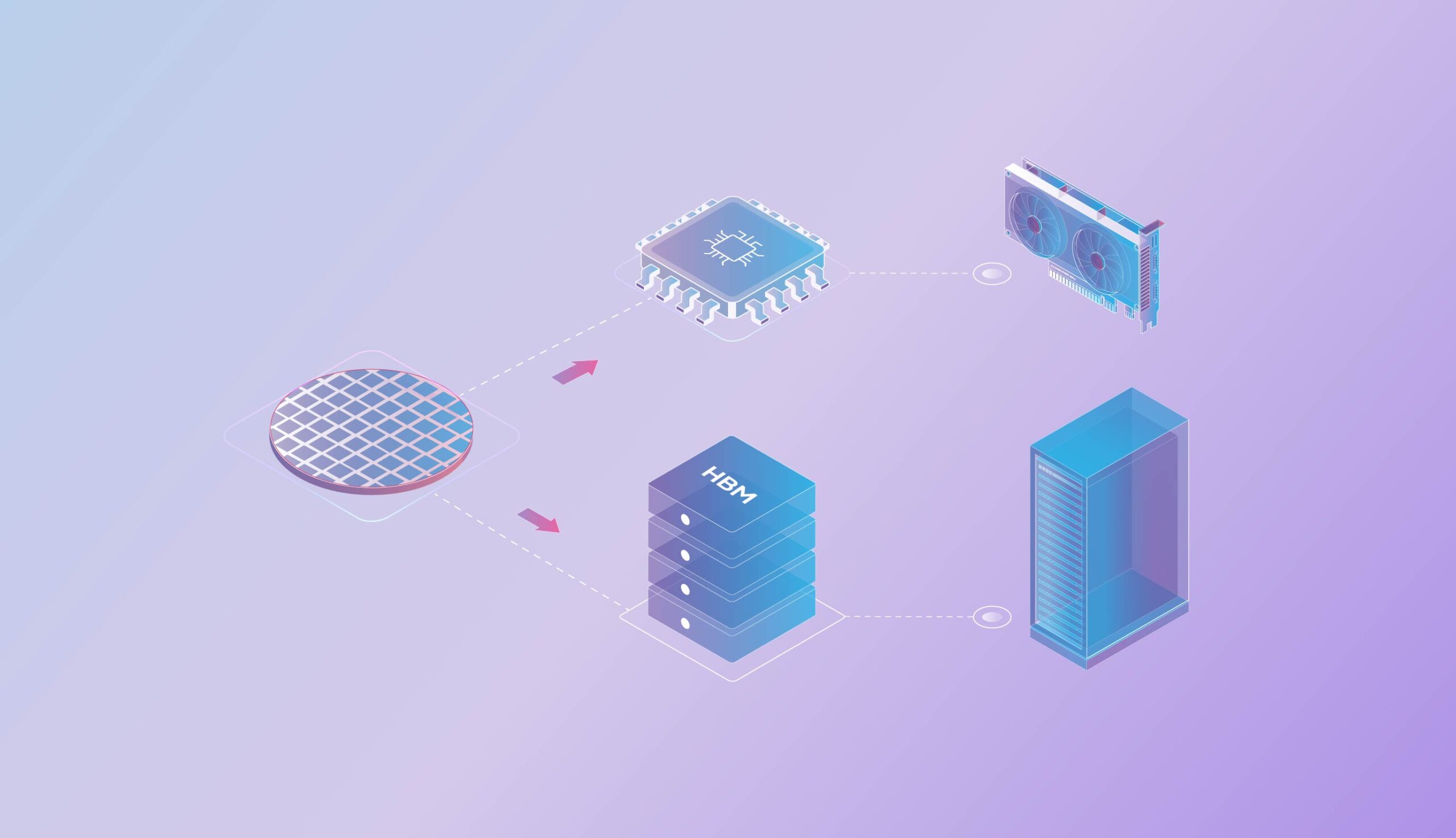
Consumer and workstation GPUs use GDDR memory (currently GDDR6 and GDDR7) which is fast, affordable to produce at scale, and well-suited to the parallel computation that graphics and AI inference workloads require. Data-center AI accelerators like the NVIDIA H100 and B200 use a different type entirely: High-Bandwidth Memory (HBM) which stacks memory dies vertically and connects them directly to the processor in a way that delivers dramatically higher bandwidth – roughly ten times what a consumer GPU gets. And at the cost of significantly more complex and expensive manufacturing.
Both types are produced by the same three companies: Samsung, SK Hynix, and Micron, which together manufacture virtually all of the world’s DRAM output. And the decision each of those companies makes about how to allocate their fab capacity between HBM and conventional GDDR is the decision that’s currently reshaping GPU pricing across the entire market.
Semiconductor fabrication capacity is NOT elastic. You cannot spin up a new memory fab in six months in response to a demand surge. The world’s three major DRAM makers have a fixed pool of wafer capacity at any given time, which means that more HBM production necessarily means less GDDR production.
Micron’s CEO, Sanjay Mehrotra, has confirmed publicly that an HBM3e die is roughly twice the size of an equivalent-capacity DDR5 module, which means that each wafer committed to HBM produces dramatically fewer memory units than the same wafer devoted to GDDR7 would. The trade-off that makes this rational for memory makers is that HBM commands a far higher price per unit from AI customers than GDDR7 commands from GPU board partners. And the AI customers are placing orders at a scale and with an urgency that makes the economics straightforward: shift capacity toward HBM, earn more per wafer, and let GDDR supply tighten.
The scale of AI infrastructure investment in 2026 is the demand context that makes everything else make sense. Microsoft, Google, Meta, Amazon, and Oracle are collectively spending approximately $600 billion on infrastructure this year, the majority of which is AI-related, with Bloomberg and other industry trackers putting the AI-specific component at roughly $450 billion – new data centers, new accelerator clusters, expanded networking and power capacity.
That level of demand sets a floor under HBM pricing and capacity allocation that doesn’t move based on consumer market conditions, quarterly earnings cycles, or the preferences of anyone outside the hyperscaler tier. Therefore memory makers optimizing for margin will continue to prioritize HBM over GDDR for as long as AI customers are willing to pay the premium that’s currently on offer.
IDC’s 2026 DRAM supply forecast puts supply growth at 16 percent year-over-year, well below the historical norm of 20 to 30 percent, specifically because HBM production is absorbing the available growth. IDC has classified the current situation as “a potentially permanent strategic reallocation” of manufacturing capacity, which is a phrase worth sitting with because it is explicitly not saying this is a temporary disruption waiting to self-correct.
NVIDIA cut RTX 50-series consumer production by 30 to 40 percent in the first half of 2026, redirecting wafer capacity toward data-center Blackwell parts where the margin per unit is multiples of what a consumer GPU generates. Windows Central reported this in March 2026,
and TechPowerUp confirmed the dynamic through board-partner sourcing shortly after. The consumer consequence is exactly what you would expect: flagships available only sporadically at their listed prices, mid-range cards settling above launch prices, and no relief visible in the production pipeline.
In July this year, NVIDIA notified its add-in board partners of a sweeping kit price increase covering both GDDR7-based Blackwell products and older cards using GDDR6, which means the pricing pressure is not confined to flagship or current-generation hardware. The notification specified increases of approximately $90 per 8 GB card, $130 per 12 GB, and $175 per 16 GB. In China, where supply chain effects tend to appear first and most sharply, GPU prices across the full lineup moved 15 to 22 percent within days of the notification reaching distributors, with retailers beginning to stockpile inventory in anticipation of further increases rather than selling through existing stock.
AMD is navigating the same constraints. The Radeon RX 9000 series uses GDDR6 rather than GDDR7, but GDDR6 supply is equally subject to the broader capacity reallocation, and AMD raised its GDDR memory kit prices to board partners by approximately 10 percent effective July 2026, with a further 10 to 15 percent increase anticipated across the lineup in the second half of the year. Intel’s Arc GPUs, which also use GDDR6, face the same exposure. There is no vendor currently using consumer graphics memory that is meaningfully insulated from the underlying shortage.
The people with the best available visibility into the supply chain are not offering a near-term answer, and the timeline projections that have been put on record publicly are sobering. Intel CEO Lip-Bu Tan stated in February 2026 that there will be “no relief until 2028,” citing direct conversations with key players in the memory industry. SK Hynix has warned that 2027 will be the worst year of the shortage and that the supply squeeze could persist into 2030, a projection the CEO shared at the company’s Nasdaq listing – not a venue associated with pessimistic spin. TrendForce’s data shows conventional DRAM contract prices rose 90 to 95 percent quarter-over-quarter in Q1 2026, with graphics DRAM seeing further increases in Q2, and Jefferies analysts have flagged anticipated increases of 50 percent in Q3 2026 and 40 percent in Q4.
For enterprises building or scaling AI infrastructure, the GPU market of 2026 changes the economics of hardware procurement in ways that extend well beyond current price quotes. Lead times on data-center GPUs – H100s, B200s, and their equivalents are running 36 to 52 weeks at most channel resellers as of mid-2026, which means hardware ordered today arrives in a procurement cycle that extends deep into 2027, at prices that are moving upward rather than downward and with no structural signal of reversal on any near-term horizon.
The calculus of owning versus accessing GPU compute – which has always been a function of utilization rate, budget predictability, and planning horizon has shifted meaningfully in the current environment, and GPU as a Service and managed infrastructure options have become increasingly rational…”
This is probably the strongest commercial interlink because that article specifically covers on-demand GPU access, pricing, commitments, and alternatives to hardware ownership.
Enterprises that need GPU compute without timing a hardware acquisition in one of the most constrained semiconductor markets in decades, on-demand infrastructure like Neysa Velocis removes the procurement risk entirely. You access capacity when you need it, without committing capital to hardware that’s appreciating in market value even as newer generations render it less competitive on performance.
If the procurement math above is relevant to decisions you’re making right now, reach out to the Neysa infrastructure team.

Hybrid AI Cloud combines on-premises systems and cloud resources, allowing businesses to securely manage sensitive data while leveraging cloud scalability for AI workloads. This approach enhances performance, compliance, and cost efficiency in various industries.
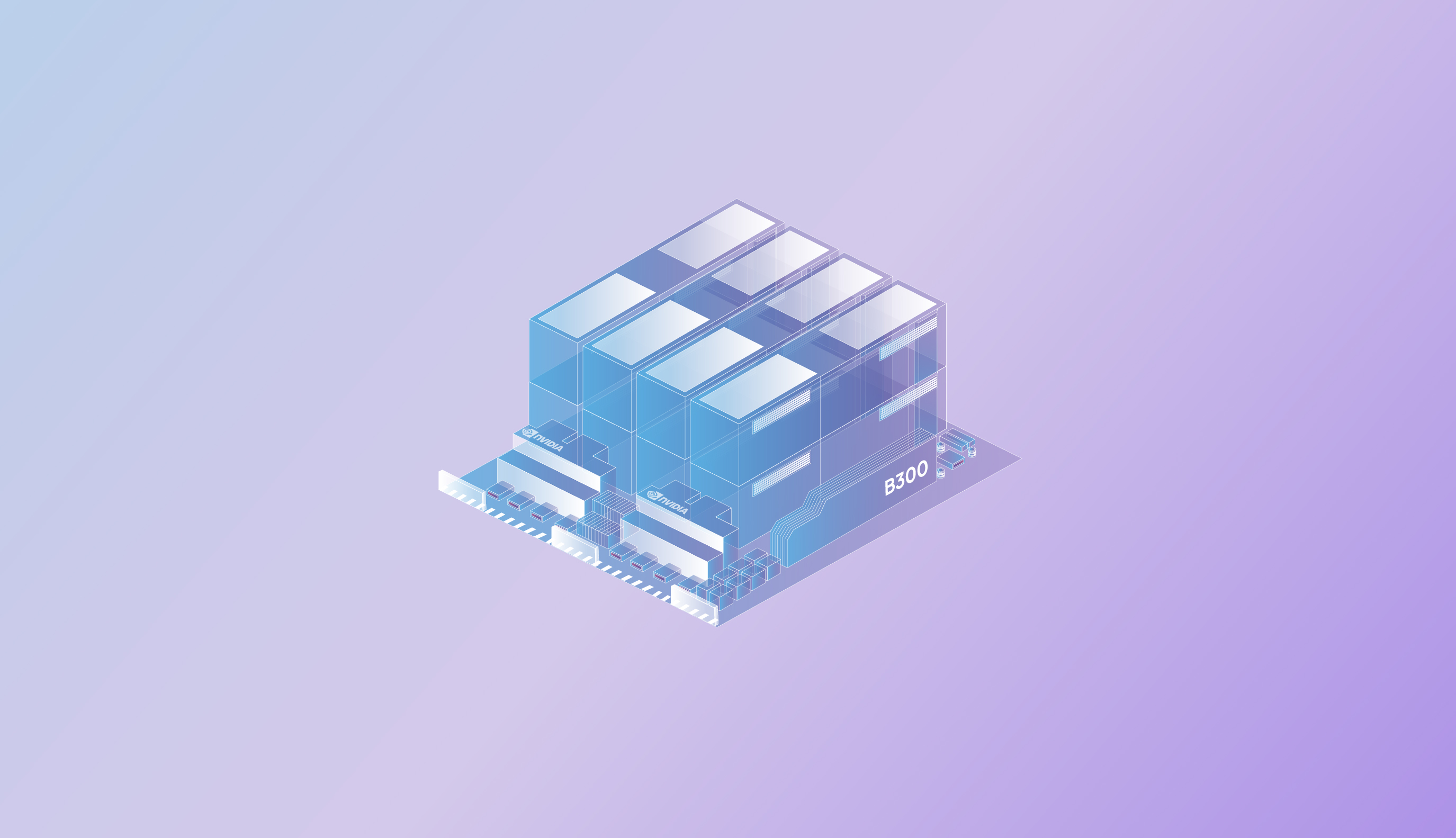
We benchmarked five models on the NVIDIA B300 – from Gemma-4-26B to GLM-5.2 at 753 billion parameters, across 18 runs under real production concurrency. The throughput numbers are strong. The TTFT finding is counterintuitive. And the infrastructure implication is bigger than either.